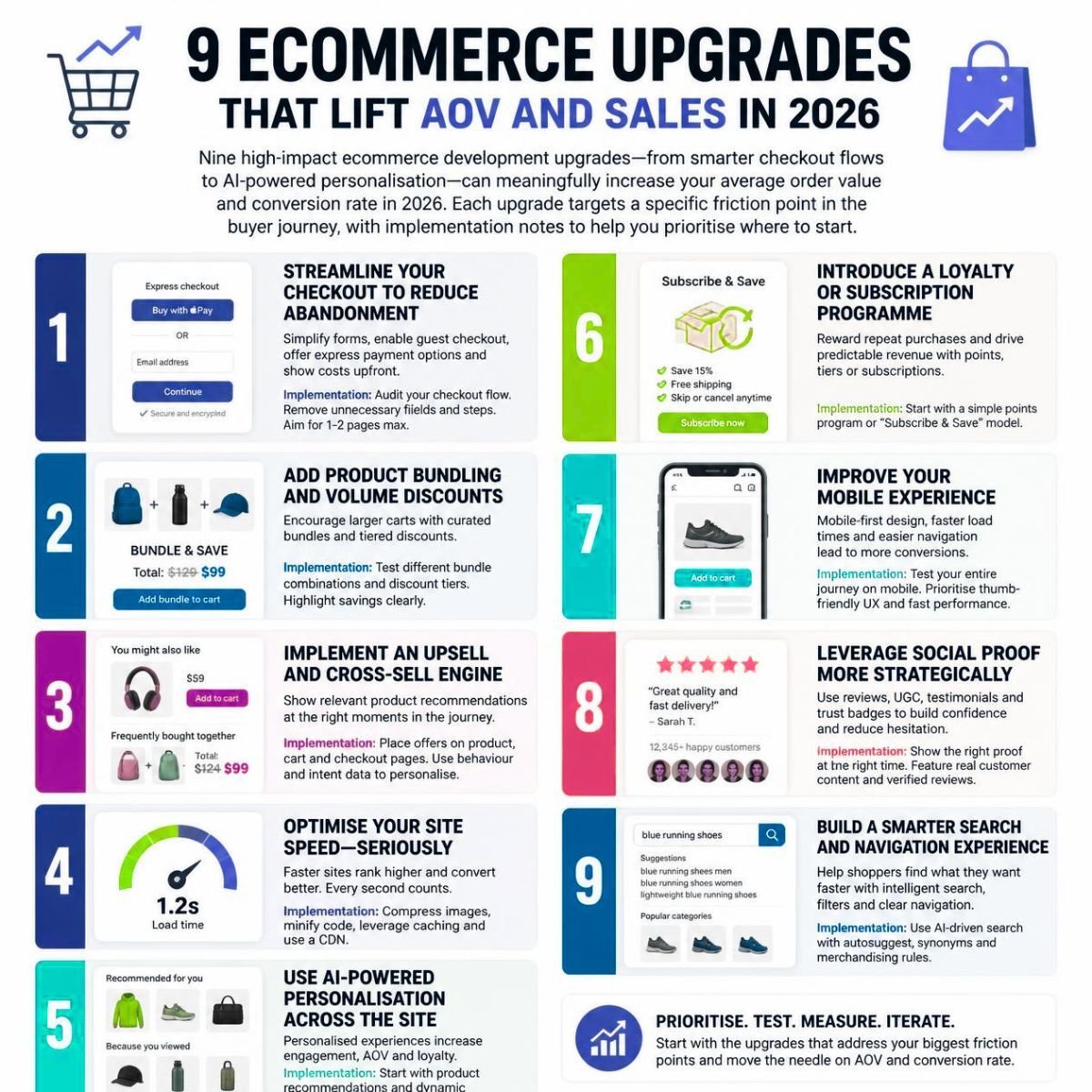
Nine high-impact ecommerce development upgrades—from smarter checkout flows to AI-powered personalisation—can meaningfully increase your average order value and conversion rate in 2026. Each upgrade targets a specific friction point in the buyer journey, with implementation notes to help you prioritise where to start.
If your ecommerce store is pulling in traffic but struggling to convert browsers into buyers—or buyers into bigger spenders—you're not alone. Most online retailers focus on acquisition and overlook the easier win: getting more value from the customers already on their site.
The good news? Strategic website and ecommerce development improvements can move the needle fast. The nine upgrades below are grounded in conversion rate optimisation best practices and are particularly relevant for mid-to-large ecommerce businesses looking to scale without simply throwing more budget at ads.
1. Streamline Your Checkout to Reduce Abandonment
Shopping cart and checkout optimisation is one of the highest-ROI investments in ecommerce. According to the Baymard Institute, the average documented cart abandonment rate is 70.19%. A significant chunk of that is caused by friction at checkout—too many steps, forced account creation, or a lack of trusted payment options.
Implementation note: Reduce your checkout to a single page where possible, offer guest checkout by default, and display trust signals (SSL badge, return policy, customer reviews) prominently.
On Shopify Plus, Checkout Extensibility lets you customise the checkout experience without sacrificing performance or security.
2. Add Product Bundling and Volume Discounts
Bundling complementary products is one of the most reliable ways to increase average order value. Customers perceive bundles as better value, and they tend to spend more when the deal feels curated rather than arbitrary.
Implementation note: Use your ecommerce platform development tools to create "frequently bought together" sections and tiered discounts (e.g., "Buy 2, save 10%. Buy 3, save 15%").
Make the savings visible and specific—vague discounts don't convert.
3. Implement an Upsell and Cross-Sell Engine
If you're not presenting upgrade options or related products at the right moment, you're leaving money on the table. Post-purchase upsells—offers shown immediately after someone clicks "buy"—convert at a surprisingly high rate because the customer is already in a buying mindset.
Implementation note: Use apps or custom ecommerce website development to trigger upsell modals at checkout or on the confirmation page.
Personalise these recommendations using purchase history and browsing behaviour where possible.
4. Optimise Your Site Speed—Seriously
A one-second delay in page load time can reduce conversions by up to 7%, according to research by Akamai.
For ecommerce sites with high traffic, that's a substantial revenue impact. Speed is also a confirmed Google ranking signal, so slow sites lose on two fronts.
Implementation note: Compress images without sacrificing quality, enable lazy loading, minimise JavaScript, and use a content delivery network (CDN). If your current platform can't keep up, it may be time to explore ecommerce platform development on a more performant stack.
5. Use AI-Powered Personalisation Across the Site
Generic product grids are becoming obsolete. AI-driven personalisation tools analyse browsing behaviour, purchase history, and real-time signals to serve each visitor a tailored experience—whether that's a customised homepage, recommended products, or dynamic search results.
Implementation note: Platforms like Shopify Plus support integrations with personalisation engines such as Nosto or LimeSpot.
Start with your homepage and product pages before expanding to email and retargeting campaigns.
6. Introduce a Loyalty or Subscription Programme
Repeat customers spend an average of 67% more than new ones, according to Bain & Company. A well-designed loyalty or subscription programme gives customers a reason to come back—and to spend more each time.
Implementation note: Subscription programmes work particularly well for consumables and replenishable products. Tools like Recharge (compatible with Shopify) allow you to set up recurring orders with flexible billing options.
Loyalty points programmes are effective across most product categories.
7. Improve Your Mobile Experience
Mobile commerce accounted for 60% of global ecommerce sales in 2023, according to Statista—and that share continues to grow. Yet many ecommerce sites still treat mobile as an afterthought, with poorly sized buttons, slow load times, and checkout flows that are painful to complete on a small screen.
Implementation note: Conduct a full mobile UX audit. Test your checkout on multiple devices, ensure tap targets are large enough, and consider implementing mobile-specific features like sticky add-to-cart buttons and swipeable product image galleries. This is a core part of modern website design and development.
8. Leverage Social Proof More Strategically
Reviews and ratings influence purchasing decisions—but placement matters as much as volume. Displaying reviews on product pages is standard; surfacing them at checkout or within upsell prompts is less common, and more effective.
Implementation note: Add star ratings to product thumbnails in search results and category pages. Use review snippets in Google Shopping listings.
If you have video testimonials or user-generated content, integrate them near the add-to-cart button where purchase intent is highest.
9. Build a Smarter Search and Navigation Experience
Poor site search is a silent conversion killer. Customers who use on-site search convert at up to three times the rate of non-searchers, according to Econsultancy—yet many ecommerce sites serve inaccurate or irrelevant results, especially for misspellings or long-tail queries.
Implementation note: Invest in an intelligent search solution that supports natural language queries, synonyms, and autocomplete with product images. Algolia and Searchanise are popular options for Shopify. Pair this with improved category page filtering to help customers find what they're looking for without friction.
Where to Start With Your Ecommerce Development Roadmap
Nine upgrades can feel overwhelming. The practical approach is to prioritise based on where your biggest drop-offs currently occur.
-
If your checkout abandonment rate is high, start there.
-
If your average order value is low despite healthy conversion, focus on bundling and upselling.
-
If mobile traffic is converting poorly, a mobile UX audit should be your first call.
The common thread across all nine upgrades is this: each one removes a friction point or creates an incentive at a specific moment in the buyer journey. That targeted approach—rather than a sweeping redesign—tends to deliver faster, more measurable results.
For ecommerce businesses ready to invest in website and ecommerce development services that drive real commercial outcomes, these upgrades offer a clear, evidence-backed place to start.
Frequently Asked Questions
What ecommerce upgrades have the biggest impact on average order value?
Product bundling, post-purchase upsells, and volume discounts consistently deliver the strongest average order value increases. These strategies work because they target customers at the point of highest purchase intent, making it easy to spend a little more without adding significant friction.
How long does it take to see results from ecommerce conversion rate optimisation?
Some changes—like adding a guest checkout option or improving site speed—can show measurable results within days. More complex upgrades, such as personalisation engines or loyalty programmes, typically take four to eight weeks to produce statistically meaningful data.
Is ecommerce website development expensive for mid-sized businesses?
Costs vary significantly based on platform, scope, and the development partner you choose. Many high-ROI improvements (checkout simplification, review placement, mobile UX fixes) are relatively low-cost to implement, especially on platforms like Shopify Plus that offer built-in customisation tools.
Which ecommerce platform is best for scaling online sales in 2026?
Shopify Plus is widely regarded as the leading ecommerce platform development option for mid-to-large businesses due to its scalability, integration ecosystem, and customisable checkout. WooCommerce remains a strong choice for businesses with specific technical requirements or existing WordPress infrastructure.
What is the difference between AOV and conversion rate optimisation?
Conversion rate optimisation (CRO) focuses on increasing the percentage of visitors who complete a purchase. Average order value (AOV) optimisation focuses on increasing how much each buyer spends. Both are key levers for online sales growth, and the most effective strategies—like intelligent upsells—improve both simultaneously.
Ready to Get Started?
Get in touch with our team today.