It’s a valid question, right? Your company just rolled out a new CRM. Or maybe it's a shiny new B2B e-commerce platform. Either way, there's an expectation — often unspoken — that you'll hit the ground running.
But here's the question nobody wants to ask out loud: are you actually doing anything to keep your skills sharp, or are you waiting for someone else to sort it out for you?
This isn't a criticism. It's a genuinely interesting tension that plays out in businesses of all sizes. Technology is moving fast. Platforms like HubSpot and Shopify are constantly evolving, adding features, changing interfaces, and raising the bar for what "competent" looks like.
The people who thrive aren't necessarily the most naturally gifted — they're the ones who take their professional development seriously and don't wait for a training invitation to land in their inbox.
This article explores the employer vs. employee training debate, why self-directed learning matters more than ever, and exactly where you can go to level up your HubSpot CRM or Shopify skills — for free, on your own schedule, starting today.
The employer vs. employee training debate
Ask ten people whose job it is to keep employees' skills current, and you'll get ten different answers. Many employees assume the company will handle it. Book a trainer, run a workshop, pay for a course — that's the employer's responsibility, right?
There's certainly merit to that view. Organisations that invest in structured training see higher adoption rates, fewer mistakes, and better outcomes from their technology investments. If a business drops a significant budget on a new platform and then provides zero onboarding support, that's a genuine failure of planning.
But here's the flip side: the digital skills landscape moves faster than most corporate training cycles. A workshop delivered six months after a platform's launch is often already out of date. New features get released quarterly. Workflows change. What worked last year may be redundant today.
The most effective professionals — the ones who consistently add value — don't treat their skills as someone else's responsibility.
They're curious. They explore. They set aside an hour a week to watch a tutorial or work through a certification. Not because HR told them to, but because staying current is part of how they do their job well.
The honest answer to the debate? It's both. But if you're waiting solely for the employer to act, you're already behind.
Why so many employees struggle with new platforms
Walk into most businesses that have recently adopted a new CRM or e-commerce system, and you'll find a familiar pattern. A handful of people have embraced it enthusiastically. A larger group are using it reluctantly and incorrectly. And a third group are actively avoiding it, defaulting to spreadsheets and workarounds they've used for years.
The issue isn't usually intelligence or willingness. It's inertia. New platforms can feel overwhelming at first glance, and without a clear path into the learning process, many people simply don't know where to start.
There's also an expectation problem. Some employees genuinely believe that if a task is part of their job, the company will train them to do it. And while that's a reasonable expectation for highly specialised or proprietary systems, it falls apart when the knowledge is freely and readily available online.
HubSpot Academy, Shopify Academy, YouTube tutorials, community forums — the resources are there. The barrier isn't access; it's initiative.
This is where a mindset shift makes all the difference.
HubSpot Academy: free training that actually makes a difference
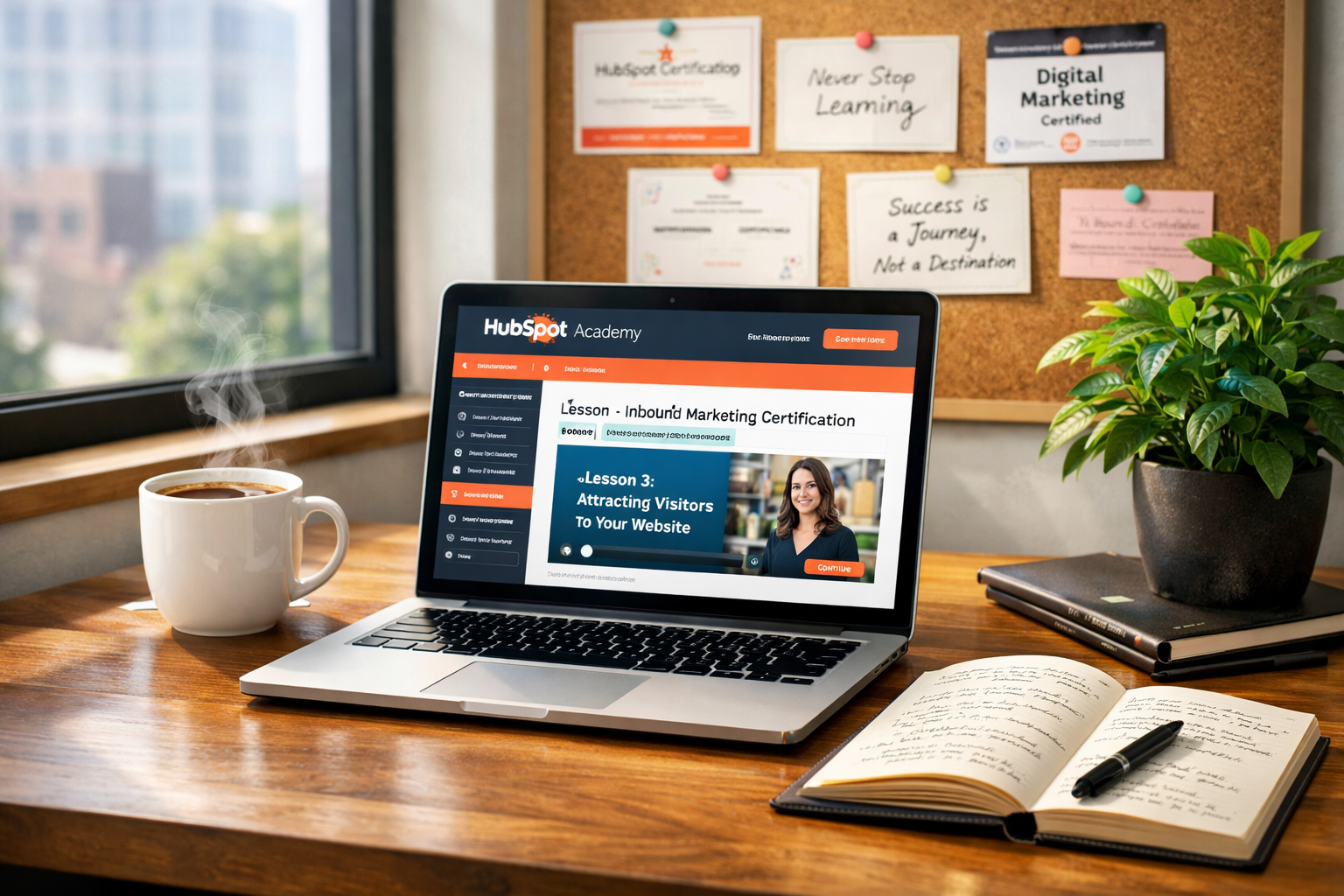
If your organisation uses HubSpot — whether for CRM, marketing automation, sales, or customer service — there is no excuse for not exploring HubSpot Academy. It is, quite simply, one of the best free learning platforms available to business professionals today.
HubSpot describes itself as "the worldwide leader in inbound marketing, sales, and customer service/support training," and the library backs that up. Courses cover everything from email marketing and SEO to revenue operations, digital advertising, and inbound sales methodology.
Every course is 100% free, available online, and accessible at any time.
Certifications that count
What sets HubSpot Academy apart from a typical YouTube rabbit hole is the certification structure. You don't just watch videos — you complete lessons, pass assessments, and earn globally recognised certificates that you can add directly to your LinkedIn profile. Over 200,000 professionals have already done exactly that.
The process is straightforward:
- Complete all lessons (video content and short quizzes)
- Pass the certification exam
- Earn your certificate and share it publicly
Popular certifications include Content Marketing (8 hours), Social Media Marketing (5 hours), Inbound (3 hours), and Inbound Sales (3 hours). Many can be completed across a few lunch breaks or commutes.
Why this matters for HubSpot CRM users specifically
If your company has adopted HubSpot CRM, the platform-specific courses are particularly valuable. The HubSpot Sales Hub Software certification, for example, walks you through the sales workspace in practical detail.
The Inbound certification teaches you the methodology that underpins how HubSpot is designed to be used — giving you the "why" behind the features, not just the "how."
Understanding the philosophy of a platform, not just its buttons and menus, is what separates competent users from genuinely capable ones.
And the HubSpot Knowledge Base is where you can quickly find clear, step-by-step answers to almost any question you have, right when you need them.
Shopify Academy: levelling up your e-commerce expertise
If your business runs on Shopify — particularly if you're working with Shopify's B2B or Plus features — Shopify Academy is the natural place to invest your learning time.
Shopify Academy offers both free and paid content across a wide range of topics: running and optimising online stores, managing Shopify POS, implementing B2B solutions, creating headless commerce experiences, and developing custom apps and themes.
The platform is designed primarily for Shopify Partners (agencies like us, developers, and consultants who work with Shopify merchants), but the knowledge is just as applicable to in-house teams working on Shopify-powered stores.
Verified skills badges
For those looking to formalise their expertise, Shopify Academy offers verified skills assessments. These are structured evaluations that, when passed, award a verified skill badge issued through Credly — a widely recognised digital credentialing platform.
Like HubSpot's certifications, these badges can be displayed on LinkedIn and other professional profiles.
It's worth noting that verified skills assessments do carry a cost, unlike HubSpot Academy's entirely free model. However, tiered discounts are available for team purchases, and voucher codes don't expire — so it's worth discussing with your employer whether they'll cover the cost as part of your professional development budget.
Verified skill badges are valid for two years, after which a reassessment is required. That built-in refresh cycle is actually a feature, not a limitation — it ensures your credentials reflect current platform knowledge, not something you learned three years ago.
The knowledge base: underrated and underused
Beyond structured courses, Shopify's Help Centre is an extraordinarily thorough resource. Step-by-step guidance on almost every feature, from basic store setup to complex B2B configurations, is available and regularly updated.
For employees working with Shopify day-to-day, developing the habit of checking the Help Centre before raising a support ticket can save significant time and build genuine platform literacy quickly.
Building a personal learning habit that sticks
Knowing the resources exist is one thing. Actually using them consistently is another.
The professionals who stay ahead don't set aside whole days for training. They work it into the margins — 30 minutes before the workday starts, a certification module over lunch, a Help Centre article when a question comes up rather than just clicking around hoping to find the answer. Small, consistent investments compound quickly.
A few practical starting points:
- Set a skills goal for the quarter. One HubSpot certification or one Shopify verified skills assessment is a tangible, achievable target.
- Use the platform as a teacher. When you encounter a feature you don't fully understand, treat it as a prompt to explore — not an obstacle to route around.
- Share what you learn. Running a brief team update on something you've picked up from HubSpot Academy, for example, reinforces your own learning and signals to colleagues and managers that you're investing in your growth.
- Keep your credentials current. Add completed certifications to your LinkedIn profile. It creates a visible record of your development and opens professional conversations.
Should your employer be doing more? Probably.
To be fair to employees who do feel underserved by their organisations: yes, employers could do more. Blocking time for training, covering certification costs, and creating a culture where upskilling is genuinely valued — not just mentioned in an onboarding document and forgotten — all make a real difference to adoption and performance.
If your organisation has invested in HubSpot or Shopify and hasn't pointed employees towards the free training resources those platforms provide, that's a missed opportunity worth raising.
A conversation with your manager about professional development — backed by specific course recommendations from HubSpot Academy or Shopify Academy — is a constructive, proactive step that demonstrates exactly the kind of initiative good employers tend to reward.
The bottom line: ownership is a competitive advantage
Platforms like HubSpot and Shopify are only as powerful as the people using them.
A CRM full of incomplete records and unused automations isn't a business asset — it's an expensive contact list.
An e-commerce platform configured by someone who only knows half its features is leaving money on the table.
The employees who understand their tools deeply — who've done the certifications, explored the knowledge bases, and built genuine expertise — consistently outperform those who've simply muddled through. Not because they're more talented, but because they've chosen to invest in themselves.
The training exists. Most of it is free. The only question is whether you're going to use it.