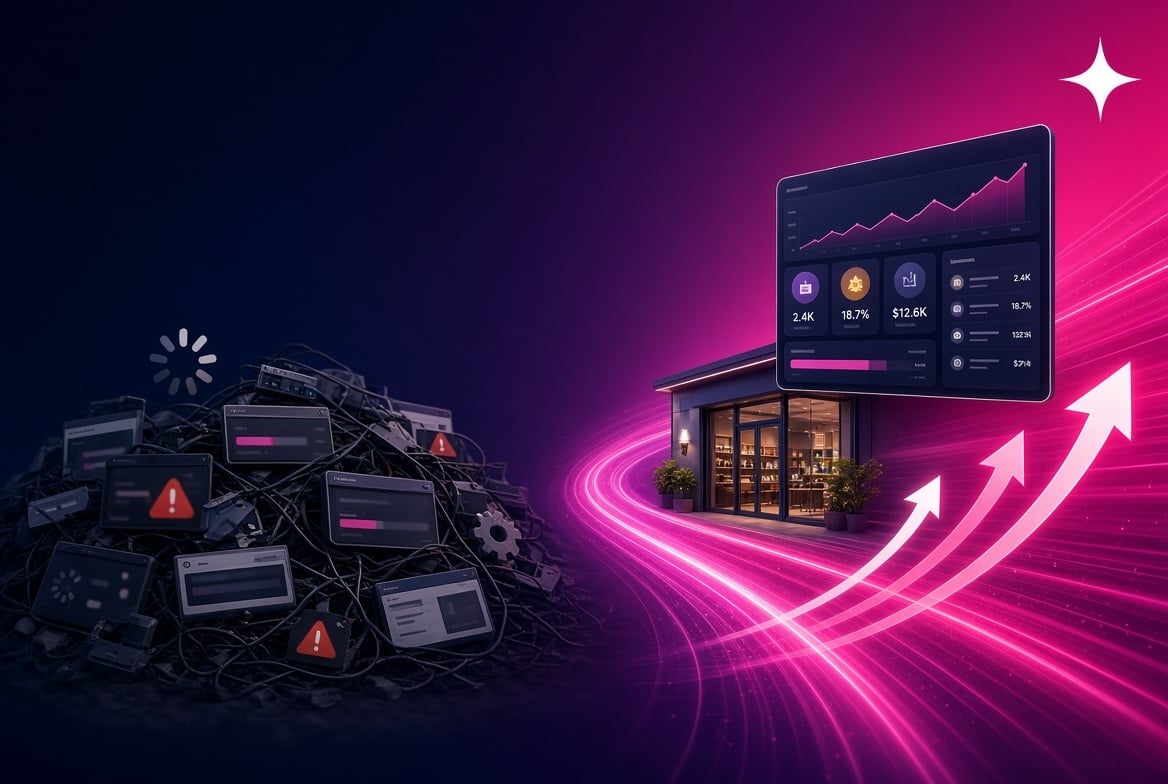
Quick answer: A disconnected approach to digital marketing happens when your content, social channels and email campaigns operate in isolation, with no clear path to purchase.
The fix is a seamless end-to-end journey—where socials act as gateways to conversion pages and checkout—powered by integrated tools like Shopify and HubSpot.
We see the same problem all the time.
A business pours hours into a brilliant YouTube channel packed with educational, authority-building content—but there's no conversion piece, so it operates as a siloed island.
Or there's a vibrant Facebook and Instagram presence that never connects to a product catalogue or checkout.
Or email campaigns that ask for a laborious read, then go absolutely nowhere. No click. No next step. No sale.
Does any of this sound like your marketing approach?
Here's the uncomfortable truth: brilliant content means very little if it doesn't lead somewhere. As my colleague Keith would say, too many businesses are busy "chumming the waters"—throwing out valuable bait to attract an audience—but never actually throwing in the hook. The effort gets wasted. The fish swim away well-fed and you go home empty-handed.
This post explains why disconnected marketing quietly drains your budget, what a connected end-to-end journey looks like, and how integrated tools turn your "edutainment" into actual revenue.
What does a disconnected marketing approach actually look like?
A disconnected approach is any marketing setup where your channels, content and data don't talk to each other. Each piece performs its job in isolation, but nothing guides the customer from awareness to purchase.
It usually shows up in three classic ways:
- Authority content with no exit ramp. Your YouTube channel or blog builds genuine trust and expertise, but there's no clear call to action, no linked landing page and no way to capture interest while it's hot.
- Social channels detached from your catalogue. Your Instagram and Facebook feeds look fantastic, yet a follower who wants to buy has to leave, open a browser, search for your site and hunt for the product themselves. Most won't bother.
- Email that reads but never clicks. Your newsletter gets opened and read, then the reader closes it. There's no compelling next step, so all that attention evaporates.
Each of these channels might look healthy on its own dashboard. The problem only becomes obvious when you ask the question that matters: where does it all lead?
Why does siloed marketing waste your budget?
Marketing silos do more than create awkward team meetings—they cost real money.
According to a Forbes report cited by Madison Logic, 65% of marketers believe silos diminish campaign clarity. When clarity drops, so does performance, because nobody can see the full picture of the customer journey.
The financial drag adds up quickly. Research from Gartner found that poor data—often a direct result of disconnected systems—costs companies an average of $12.9 million annually. That figure reflects wasted spend, missed opportunities and decisions made on incomplete information.
The conversion gap is just as telling. The average e-commerce conversion rate in 2025 sits between roughly 2.5% and 3% worldwide, according to multiple industry studies. If your channels aren't feeding into a smooth conversion path, you're likely leaving the majority of your hard-won traffic on the table. Every disconnected click is a potential customer who showed interest and then hit a dead end.
Put simply: you can have the best content in your industry and still lose, if that content has nowhere to send people.
What is an end-to-end marketing approach?
An end-to-end approach connects every stage of the customer journey into one continuous flow. Your social channels act as the gateway. They lead to conversion pages designed to turn interest into intent. Those pages, in turn, lead to checkout—so a curious browser can become a paying customer without ever hitting a dead end.
Think of it as a guided path rather than a scattering of stepping stones.
Instead of asking your audience to do the work of finding you again, you take them on the journey yourself.
This is where "edutainment" earns its keep. Educational, entertaining content is brilliant for building trust and attracting an audience—but it needs a destination. When your value-packed content links directly to a relevant offer, the trust you've built converts into action. You stop chumming the waters and start landing the catch.
For medium to large enterprises selling through multiple channels, this connected model is what separates a busy marketing operation from a profitable one.
Why are Shopify and HubSpot the perfect conversion tools?
Building a connected journey requires tools that share data and work together. Shopify and HubSpot are a strong combination for exactly this reason—one handles the commerce, the other handles the customer relationship, and together they close the loop between content and conversion.
How Shopify and HubSpot work together
HubSpot's own Shopify integration syncs your store data directly into your CRM. If you rerad HubSpot's marketplace listing, the integration lets teams "personalise campaigns, automate follow-ups, and measure" results by tying store revenue back to specific conversions, emails and campaigns. In practice, that means:
- Unified customer data. Order history, customer details and store activity flow into HubSpot, giving you a single, real-time view of each buyer instead of scattered fragments across platforms.
- Automated abandoned cart recovery. Once Shopify is connected, HubSpot can add a cart module to automated emails that includes the actual items a shopper left behind—turning a lost sale into a recoverable one.
- Revenue-attributed campaigns. You can finally tie store revenue to the specific email, ad or social post that drove it, so you know which content actually earns money rather than just attention.
Choosing the right setup for your business
Choose this integrated approach if connecting your marketing to measurable revenue matters more than keeping your current tools comfortable but siloed.
For enterprises already running Shopify, HubSpot, ERP or CRM systems, the value lies in stitching these together so data flows automatically rather than living in separate boxes.
When your social media is tied into this engine, you're no longer posting and hoping. You're taking potential buyers on a deliberate journey that leads somewhere—from the first scroll to the final checkout.
Stop feeding the fish—throw the hook
A disconnected approach isn't a sign you're doing the wrong things.
More often, it means you're doing many of the right things in isolation. Great content, engaged social followers and opened emails are all genuine assets. They're just not pulling together.
The fix is connection. Map the journey from your socials to your conversion pages to your checkout, then use integrated tools like Shopify and HubSpot to make that journey seamless and measurable. Your edutainment finally leads somewhere, your data tells one clear story, and your effort stops going to waste.
Are you ready to connect the dots?
Are you ready to get honest?
Take an honest look at your top-performing piece of content and ask one question: where does it lead? If the answer is "nowhere", that's your starting point.
Don't leave them feeding without throwing the hook.