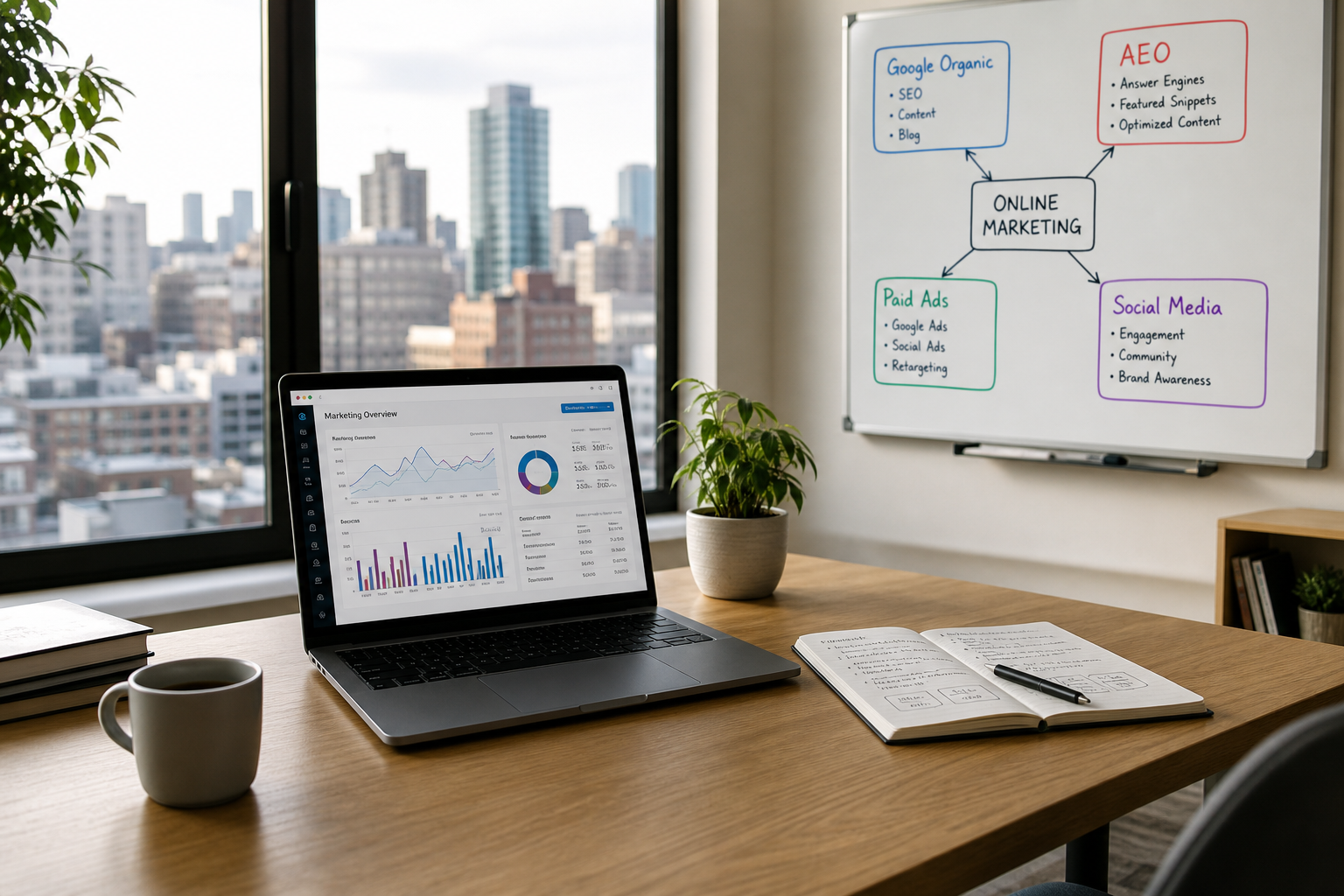
There's no single best channel for online visibility — the right mix depends on your budget, timeline, and audience. Google Organic Search builds long-term authority, AEO targets AI-generated answers, Paid Ads deliver immediate results, and Social Media drives community and discovery. Most businesses benefit from combining all four.
Getting found online has never been more complicated — or more important. A few years ago, the debate was simple: rank on Google or run ads. Now, with AI-powered search engines summarising answers before users even click a link, and social platforms becoming discovery engines in their own right, the question of where to focus your efforts has become a lot harder to answer.
This post breaks down the four main approaches to online visibility — Google Organic Search, Answer Engine Optimisation (AEO), Paid Ads, and Social Media — and gives you an honest look at the pros, cons, and best use cases for each. By the end, you'll have a clearer picture of where to put your energy (and budget).
What is Google Organic Search — and is SEO still worth it?
Google Organic Search refers to the unpaid results that appear when someone searches for a query on Google. Ranking well here depends on Search Engine Optimisation (SEO) — a combination of quality content, technical website health, backlinks, and user experience signals.
SEO has been the cornerstone of digital marketing for over two decades, and it remains one of the highest-ROI channels available — but it's slow. New websites can take six to twelve months to see meaningful traction.
Pros:
- Builds long-term, compounding traffic over time
- High credibility — users trust organic results more than ads
- Cost-effective once rankings are established
- Captures high-intent users actively searching for solutions
Cons:
- Slow to show results — requires sustained effort and patience
- Highly competitive in most industries
- Algorithm updates can shift rankings overnight
- Requires ongoing investment in content and technical maintenance
Best for: Businesses with a medium-to-long-term growth strategy, content-led brands, and any organisation looking to reduce reliance on paid spend over time.
What is AEO — and why does it matter now?
Answer Engine Optimisation (AEO) is the practice of structuring your content so it surfaces in AI-generated responses — think Google's AI Overviews, ChatGPT, Perplexity, and similar tools. Rather than optimising purely for clicks, AEO focuses on being the source that AI systems cite and quote.
This is a relatively new discipline, but it's growing fast. As of 2024, Google's AI Overviews appear for an estimated 15–18% of all queries, according to data from Search Engine Land — and that number is rising.
The key to AEO is writing content that's clear, factual, and structured in a way that makes it easy for AI models to extract and attribute. Think direct answers, FAQ sections, and well-organised headings.
Pros:
- Positions your brand as an authoritative source in AI-generated results
- Captures visibility even when users don't click through
- Future-proofs your content strategy as AI search grows
- Complements existing SEO efforts rather than replacing them
Cons:
- Still an emerging field — best practices are evolving quickly
- May drive brand visibility without generating direct website traffic
- Harder to measure ROI compared to traditional SEO
- Requires a shift in how content is structured and written
Best for: Brands focused on thought leadership, content-heavy businesses, and organisations looking to stay ahead of the curve as AI search becomes mainstream.
What are Paid Ads — and when do they make sense?
Paid Ads — primarily Google Search Ads (Pay-Per-Click) and display advertising — put your business at the top of search results immediately. You pay each time someone clicks your ad, with costs varying by industry and keyword competition.
Google Ads can be extraordinarily effective when used strategically. The average Google Ads conversion rate across industries sits at around 4.4%, according to WordStream — significantly higher than many other digital channels.
That said, the moment you stop paying, the traffic stops. Paid Ads are a tap, not a well.
Pros:
- Immediate visibility — ads can go live within hours
- Highly targeted — reach specific demographics, locations, and search intents
- Measurable ROI with detailed performance data
- Scalable — increase spend when campaigns perform well
Cons:
- Costs can escalate quickly, particularly in competitive industries
- No residual value — traffic disappears the moment your budget runs out
- Increasing ad blindness among users — many people scroll past ads automatically
- Requires ongoing management and optimisation to stay cost-effective
Best for: Businesses with a defined budget, product launches, time-sensitive promotions, and organisations that need traffic quickly while their organic strategy matures.
What about Social Media — can it compete as a discovery channel?
Social Media has quietly evolved from a community-building tool into a genuine search and discovery engine. According to a 2023 report by Adobe, roughly 40% of Gen Z users prefer searching on TikTok or Instagram over Google for certain types of queries — particularly lifestyle, food, travel, and product discovery.
Platforms like LinkedIn, Instagram, TikTok, YouTube, and Facebook all have their own algorithms that can amplify content to users who weren't actively searching for it. That's a fundamentally different — and powerful — type of visibility.
Pros:
- Builds brand awareness and community alongside traffic
- Organic reach is possible without significant ad spend (particularly on TikTok and LinkedIn)
- Drives discovery among users who aren't in active research mode
- Supports other channels — social proof and brand familiarity improve conversion rates elsewhere
Cons:
- Algorithm-dependent — reach can drop without warning
- Content has a short shelf life compared to evergreen blog posts or web pages
- Time-intensive to produce consistent, high-quality content
- Weaker for capturing high-intent, purchase-ready audiences
Best for: B2C brands, visual industries (hospitality, fashion, food), thought leaders on LinkedIn, and any business targeting younger demographics.
So, which approach should you choose?
The honest answer? All of them — but in the right proportions for your situation.
Here's a practical framework:
- If you need traffic now: Start with Paid Ads while your organic strategy builds momentum.
- If you're playing a long game: Prioritise SEO and AEO for sustainable, compounding visibility.
- If your audience is on social: Invest in platform-specific content to build brand recognition and community.
- If you want to future-proof your visibility: AEO is the channel most businesses are underinvesting in right now.
The businesses that tend to dominate online aren't choosing one channel — they're using each one strategically, with a clear understanding of what each does best.
Frequently Asked Questions
What is the difference between SEO and AEO?
SEO (Search Engine Optimisation) focuses on ranking in traditional search engine results pages, while AEO (Answer Engine Optimisation) focuses on appearing in AI-generated answers from tools like Google's AI Overviews, ChatGPT, and Perplexity. AEO prioritises direct, structured answers that AI systems can easily extract and attribute.
How long does it take to see results from Google Organic Search?
Most websites take between six and twelve months to see meaningful organic traffic growth, depending on the competitiveness of the industry and the quality of the SEO strategy. New websites with little authority typically sit at the longer end of that range.
Are Google Ads worth it for small-medium businesses?
Google Ads can be effective for small businesses, particularly for local services or time-sensitive campaigns. The key is starting with a tightly focused campaign — specific keywords, a defined geography, and a clear conversion goal — rather than casting a wide net with a limited budget.
Can social media replace SEO?
No. Social media and SEO serve different purposes. Social media excels at brand discovery and community building, while SEO captures high-intent users actively searching for a solution. The two channels are complementary, not interchangeable.
Is AEO relevant for small-medium businesses?
Yes — in fact, smaller businesses can punch above their weight with AEO. Because the field is still emerging, well-structured, authoritative content has a real chance of being cited by AI tools, even without the domain authority required to rank highly in traditional search.